Location-Based Ads Get Opt-In, Geofencing — But Does That Help?

Everybody knows about the Starbucks example of location-based ads: you walk past a coffee shop, and it sends a coupon enticing you inside to your phone. Most sensible people realize it’s not a great idea (see Russell’s definitive fisking of the concept), but the idea lives on. Monday’s NYT had a story about how clothing brand The North Face is starting a location-based ad program (powered by Placecast) that uses geofences to determine when to send messages to users who have opted in.

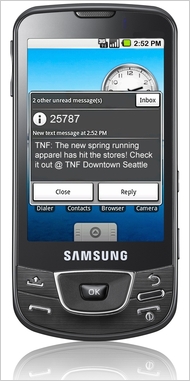
The article says that users who come within a half-mile of one of TNF’s urban stores (or 1 mile of its suburban stores) will get sent some sort of come-hither message (like “The new spring running apparel has hit the stores! Check it out @ TNF Downtown Seattle.”), and eventually, they’ll send messages to people who visit certain hiking trails or ski slopes with weather conditions or other info. Placecast has evidently set up 1,000 geofenced areas across the US that will trigger messages from The North Face to users.

It’s great that the system is opt-in; that answers one of the major criticisms of the Starbucks example. The geofencing is a slightly more advanced location technology; adding in areas other than the stores is definitely new. But do these additions make the overall concept any stronger?

That’s not totally clear. Placecast says they won’t send a user more than 3 messages per week, but it’s the content of those messages that’s more important than their frequency. If you go to downtown Seattle and get messages you aren’t interested in from TNF every time you’re near their store, how long will you stay opted in? What will be the effect on your perception of the brand? And further, what value does a “come into the store to see some new stuff we want to sell you” message offer to the recipient? Not much, I’d say — even less if it’s not well-targeted.

What seems to often be forgotten in the discussion around LBS advertising — especially models like this — is what they offer the recipient. Simply delivering better targeted ads is a benefit for marketers, and is not inherently one for customers, too. If a customer opts in to receive messages from a brand or retailer, they’ve got to offer something of value. That doesn’t mean that every message has to be a hugely valuable coupon or be something else of tangible value, but they have to be worthwhile in some way.

Every message sent out has a negative value potential. That is, each time you contact a customer there’s the potential that the message is hurting your relationship with them, rather than helping it. If you’re setting up all these geofences that will trigger your messages, and thereby increasing the volume you’re sending, it puts quite a burden on you to ensure that each message is meaningful and valuable. Location targeting doesn’t help you get around this, regardless of how well it works.

—–>Follow us on Twitter too: @russellbuckley and @caaarlo

Share this post:
  • Facebook
  • Twitter
  • del.icio.us
  • StumbleUpon
  • Digg
  • LinkedIn
  • Google Bookmarks
  • Suggest to Techmeme via Twitter
  • Reddit
  • "Simply delivering better targeted ads is a benefit for marketers, and is not inherently one for customers, too"

    Crassly speaking, that applies to all advertising to a certain degree. It's only a matter of when the gray area turns dark enough.

    I'm not defending located advertising per se, but to me the rationale for doing located advertising would be to pull in the customer in the moment and vicinity, and with a tangible value proposition. Otherwise there's no point of doing that.

    It would be rather distracting getting such messages while driving, and it would be hard to follow them without driving into a ditch. Speech would have solved that, but phone manufacturers have still not realized that's a good way of being in the know while driving.

    So for practical reasons it sounds like it applies better to e.g. malls and air ports. When you are at an air port you are primarily worried about catching the flight, so to grab the attention of a passer-by this could be a nifty and very local way of achieving attention. Of course then we are talking Bluetooth rather than cell or GPS location.

    Also, if you are a member of a retail brand you could get such messages when you are close to or in such a shop, instead of having to look up what is being rebated right now.

    As you say, this could also hurt the brand, but where to draw the line? If you are a rather unknown player, this could be an inexpensive way of creating attention.
  • "Simply delivering better targeted ads is a benefit for marketers, and is not inherently one for customers, too"

    Crassly speaking, that applies to all advertising to a certain degree. It's only a matter of when the gray area turns dark enough.

    I'm not defending located advertising per se, but to me the rationale for doing located advertising would be to pull in the customer in the moment and vicinity, and with a tangible value proposition. Otherwise there's no point of doing that.

    It would be rather distracting getting such messages while driving, and it would be hard to follow them without driving into a ditch. Speech would have solved that, but phone manufacturers have still not realized that's a good way of being in the know while driving.

    So for practical reasons it sounds like it applies better to e.g. malls and air ports. When you are at an air port you are primarily worried about catching the flight, so to grab the attention of a passer-by this could be a nifty and very local way of achieving attention. Of course then we are talking Bluetooth rather than cell or GPS location.

    Also, if you are a member of a retail brand you could get such messages when you are close to or in such a shop, instead of having to look up what is being rebated right now.

    As you say, this could also hurt the brand, but where to draw the line? If you are a rather unknown player, this could be an inexpensive way of creating attention.
  • Every time I get a txt msg on my phone with an offer, no matter how great the offer and if I decide to take advantage of it, I get ticked off and assign a negative point to the vendor who sent it to me. I don't know what it is but it is and I know I'm not the only one. I'm less irritated when going through an street market and people tap me on the shoulder trying to sell me stuff than I am when I get a txt on my mobile.
  • Every time I get a txt msg on my phone with an offer, no matter how great the offer and if I decide to take advantage of it, I get ticked off and assign a negative point to the vendor who sent it to me. I don't know what it is but it is and I know I'm not the only one. I'm less irritated when going through an street market and people tap me on the shoulder trying to sell me stuff than I am when I get a txt on my mobile.
  • How long with this hyped "Starbuck's" model be thrown out there as the ultimate game changer? It is not the end all be all answer to every shopper's greatest wish, in fact, it will probably turn people off of a brand quicker than bluespam did in Europe. Trying to engage a shopper into the shopping experience if you're not sure they are in shopping mode is a bad idea and a huge turn off. There are far too many variables to make assumptions that because I am walking by the North Face and I happen to have shopped there before, that I am a ready buyer. This is much different that browsing a skiing website and seeing a North Face ad. The mobile experience is far too personal to ever send something that could be construed as a non-relevant irritant - which this will be, even if someone opts in for it. What might work is if someone enters a mall and maybe 5 texts stream (only once when they first enter) in from their fave merchants, the assumption being that they have arrived at the mall and intend to shop. In the mall example, geofencing should work. I'm still not sure how they do it with non-smartphones. Also, don't underestimate the difficulty of the opt-in process.
  • How long with this hyped "Starbuck's" model be thrown out there as the ultimate game changer? It is not the end all be all answer to every shopper's greatest wish, in fact, it will probably turn people off of a brand quicker than bluespam did in Europe. Trying to engage a shopper into the shopping experience if you're not sure they are in shopping mode is a bad idea and a huge turn off. There are far too many variables to make assumptions that because I am walking by the North Face and I happen to have shopped there before, that I am a ready buyer. This is much different that browsing a skiing website and seeing a North Face ad. The mobile experience is far too personal to ever send something that could be construed as a non-relevant irritant - which this will be, even if someone opts in for it. What might work is if someone enters a mall and maybe 5 texts stream (only once when they first enter) in from their fave merchants, the assumption being that they have arrived at the mall and intend to shop. In the mall example, geofencing should work. I'm still not sure how they do it with non-smartphones. Also, don't underestimate the difficulty of the opt-in process.
  • This reminds me of the BlueSpam marketing trial by the bank in the UK where everyone passing by received a message if they had their phone set to receive. This enticed people to come into the bank alright, but not to open an account....it was to complain. This mobile marketing trial was quickly shut down.

    What the bank realized was people don't want to just randomly receive messages on their mobile devices. They want it to have immediate relevance with an offer that is actually worth something.

    Starbucks knows this now. The North Face will realize it soon. What will happen is The North Face will spend time and money signing up their most loyal customers. Then, they will start to send out meaningless messages when these most loyal customers are near...resulting in one to many messages eventually. Then, this will cause these most loyal customers to opt out... All that money and time wasted.

    What they really need to focus on is meaningful messages that have immediate relevance, regardless of the location of their loyal customers. Loyal customers that have trusted you with their cell numbers will travel for the right offer. No one wants their phones pinging every time they are near your store.
  • You can do some awesome stuff with LBS technology, this isn't really one of them. There isn't much incentive in that message (yet) but even then how many North Face customers shop there 3 times a week, or even a month?
blog comments powered by Disqus